What is an NCUA DOR?
Updated: Aug 5
A Document of Resolution is the part of your examination report where NCUA tells you what you have to fix, who has to fix it, and by when. It's an informal administrative remedy, and it's the only one your examiner can put in the report without the Regional Director signing off.
Every other informal action has to go up the chain: a Regional Director Letter, an unpublished LUA, a preliminary warning letter. The NSPM puts it plainly, that with the exception of a DOR, the RD must approve all informal actions. The person deciding whether you get a DOR is usually sitting in your conference room, which means so is the person who can take it back out.
Where a DOR sits in the hierarchy
NCUA sorts administrative remedies into informal and formal. Informal actions are the DOR, the RDL, the non-published LUA, and the preliminary warning letter. Formal actions are published LUAs, cease and desist orders, civil money penalties, conservatorship, liquidation, removal and prohibition, termination of insurance, and certain PCA actions.
The NSPM reserves the term “enforcement actions” for the formal list, which puts a DOR at the bottom of the ladder while producing the administrative record everything above it gets built on.
What has to be true before an examiner writes one
Finding a problem isn't enough. NSPM Version 26.0, Document of Resolution section, last updated July 10, 2026: problems in a DOR must be significant enough that the examiner would recommend escalating to the next level of elevated enforcement action for failure to correct. If your examiner wouldn't recommend an RDL or an LUA over it, it doesn't belong in the DOR, and that's the test I'd anchor on in any negotiation.
Four questions follow:
• If left unresolved, could the problem cause serious financial or operational damage?
• Does the problem result in significant noncompliance with laws or regulations?
• Would it need to be escalated to the next level of enforcement action (PWL, LUA, C&D, or conservatorship) if unresolved?
• Is the problem widespread throughout the credit union?
Examiner judgment still governs, so none of this runs itself.
One thing to listen for. A fifth question used to sit in that list, asking whether the problem resulted from management's inability or unwillingness to properly identify, measure, monitor, and control risk. It was the catchall that fit almost anything, and it isn't in the current manual. An examiner working from habit or older training may still reach for it, and if you hear it, it isn't a criterion any more.
A DOR can only address three things
The current manual tells examiners to include only actions addressing material financial risk, significant noncompliance with law or regulation, or substantial safety and soundness concerns. That's a narrow list, and it's quotable back at an examiner who's loading up the report with everything they found.
The same section says a DOR should go after the root cause rather than the symptom. Its own example: a credit union with accounts out of balance shouldn't just be told to balance the accounts, but to fix the staffing, controls, and procedures that let it happen. Corrective actions should also focus on the desired end result, not the pathway to it, which is your ground for pushing back when an examiner prescribes a specific method rather than an outcome.
Examiners may not cite you for violating guidance
In the References material, updated July 10, 2026, the manual states that guidance and manuals do not have the force and effect of law and that NCUA does not take enforcement actions based on such guidance. Examiners may not criticize a credit union for “violating” guidance or a manual. The point is repeated as a standalone line: examiners may not cite a credit union for violating guidance.
If a DOR item rests on an FFIEC handbook, a letter to credit unions, or an examiner's sense of best practice, with no statute, regulation, or bylaw underneath it, you have a specific objection with a citation attached.
The Administrative Remedies chapter opens with a related section titled “No Regulation by Enforcement.” It states that regulation by enforcement is impermissible, that staff will seek to remedy problems before resorting to enforcement actions, and that enforcement should only occur where there is material risk or likely material harm, clear and significant violations of law or regulation, or a breach of fiduciary duty. It adds that staff will not take enforcement actions to boost the agency’s totals or to set policy.
An examiner can tell you that section doesn't reach a DOR, since the NSPM defines enforcement actions as the formal ones, and they would have the definitional argument on their side. The counterweight is placement. The chapter's own opening sentence defines administrative remedies to include DORs by name, and NCUA put that statement at the top of the chapter that governs them. Use it to set the tone of the conversation, and use the guidance prohibition for the actual fight.
The parts you can check line by line
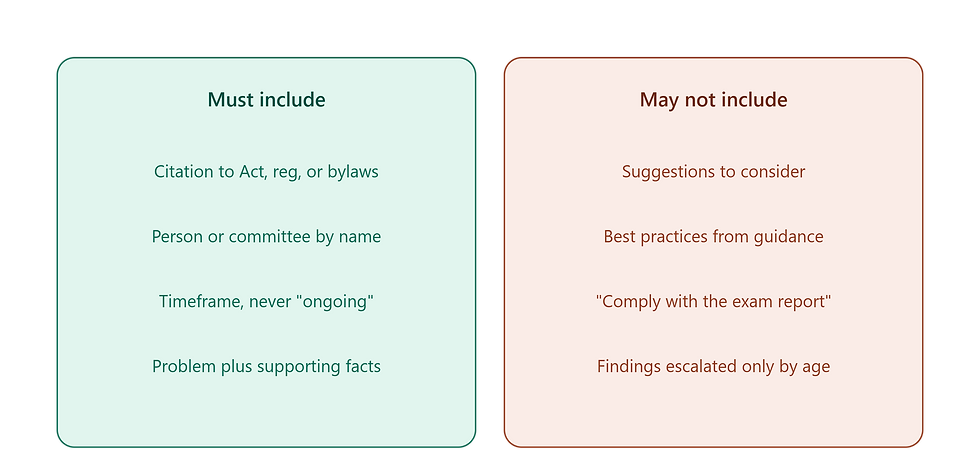
A DOR must:
• Concisely describe the problem, including all supporting facts
• Cite the specific section of the FCU Act, NCUA regulations, or the bylaws. For safety and soundness concerns, § 206(b)(1) of the Act or § 741.3
• Identify the specific person or committee responsible, by name and title
• Include a timeframe for completion. Examiners may not state “ongoing”
• Follow SMART: specific, measurable, achievable, results-oriented, timely
It may not include suggestions or items for management to consider, best practices drawn from guidance, references to Supplementary Facts, broad statements telling you to “comply with the examination report,” or Examiner’s Findings escalated only because they went unresolved.
Hold your draft against that list. An item with no citation, no named owner, or a timeframe of “ongoing” is unfinished under NCUA's own standard, and pointing that out is a factual observation.
Negotiating it
The manual says examiners will use a collaborative approach with credit union management, and that if management develops corrective action that's sustainable, lawful, prudent, and solves the problem, the examiner should use it and note that management developed it.
That language matters because the DOR you first see is a draft. NCUA’s own hierarchy supports treating it as negotiable: the next step up, the letter of understanding and agreement, has the word agreement in its name. If an LUA gets negotiated, so does a DOR.
Sometimes you'll decide to go along to get along, agreeing to something you don't fully believe is a problem because it costs less than the fight. That's a legitimate choice and often the right one. Accepting facts that are wrong is different, and that's where to hold the line.
Tracking, and who gets one
DOR items are entered as Issues in MERIT, tracked across exams, and closed when the corrective action is implemented, even if the ratios haven't caught up yet.
Any CAMELS code can get one a DOR. A code 1 can get a DOR, a code 5 can get a DOR, and if you're a code 3 you should expect one, though I've seen exceptions.
One caveat on negotiation. If the item is a BSA violation, you're not talking it out of the DOR. NCUA has an agreement with FinCEN that those go in, and the examiner has no discretion to move it. Your only opening is factual: if they have the facts wrong, that's a different conversation.
Reach out to learn how we assist our clients with NCUA so they save time and money.


Comments