Can a DOR Cost a Credit Union CEO their Job?
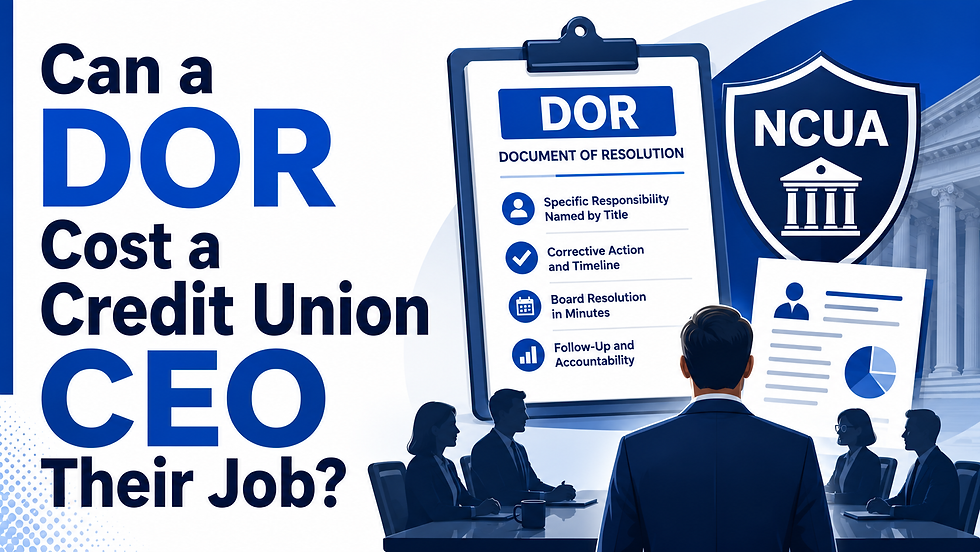
A Document of Resolution (DOR) cannot cost a chief executive officer (CEO) their job by itself, because the National Credit Union Administration (NCUA) has no authority to decide who a credit union employs. What a DOR does is build a written record of who owed a correction and whether they delivered it, and boards make employment decisions off records like that.
What NCUA can actually do about a CEO
Who the credit union employs is the credit union’s call. Examiners identify deficiencies and escalate when those go uncorrected, and they do not get to name the person who leaves. A DOR is reserved for problems significant enough that an examiner would recommend escalating to the next level of enforcement action for failure to correct them (National Supervision Policy Manual (NSPM) 26.0, Document of Resolution, page 223), so a board receiving one has been told the stakes.
NCUA’s direct authority over individuals sits outside the examination report. Removal under § 206(g) of the Federal Credit Union Act requires a breach of fiduciary duty, a board that will not or cannot discharge the person, and a person who will not resign. Under Prompt Corrective Action (PCA), the NCUA Board can require a credit union classified below “undercapitalized” to dismiss a director or senior executive officer. Neither runs through a DOR.
Your Name/ Title goes on the DOR
NSPM 26.0 requires examiners to identify the specific person or committee responsible for correcting each DOR item by name and title (Development Process, page 229). NSPM 10.0 carried the same instruction qualified with “where applicable”; 26.0 dropped the qualifier. That section was last updated July 10, 2026, so an examiner or a credit union working from the older language may still treat naming an individual as discretionary, and as the manual reads now it is not.
The same section has examiners ask the board of directors to enter a formal resolution into the minutes documenting agreement to resolve all DOR items. The record then shows a board that formally committed to corrective action and an executive named by title as the person who owed it.
Where an unresolved DOR becomes a rating problem
NSPM 26.0 instructs exam staff to consider the quality of management and to weigh management’s failure to resolve problems in the management CAMELS component and the overall composite rating (Recurring or Unresolved DOR Items, page 236). Repeat items carry an asterisk and a footnote marking them as repeat or carry-over. The manual also says numerous uncorrected Examiner’s Findings may indicate uncooperative or ineffective management, and that a DOR written to address that management may be warranted (Exclusions, page 227).
Mark’s read on “unwilling or unable” is that it is code for at least a management 3, since that language is the CAMELS definition for the management component. A management 4 obligates the examiner to document deficient management and board performance, an excessive level of risk exposure, and inadequate control of significant risks (Examination Overview, page 222). That is a written case about named leadership, sitting in the report your board reads.
The organizational review is the closest NCUA gets
Steve Farrar’s rule of thumb: once your examiner starts talking about an organizational study or an assessment of senior management, things are very serious, and your CAMELS rating should already reflect that. Todd Miller adds that by the time NCUA issues a DOR of this kind, the agency has concluded management is unwilling or unable to fix the underlying problems.
The DOR language Steve has seen is consistent: engage a third party to assess the organizational structure, including senior management, covering staffing and separation of duties, management qualifications and performance evaluations, job descriptions, training, and reporting to the board. Get your examiner’s approval of the third party before signing the engagement.
Todd issued these as a problem case officer and later as a director of special actions. In those cases the agency generally already knew which employees needed to be replaced or moved, and the review was how that conclusion reached the board, on the reasoning that a competent third party would identify the same weaknesses on its own. He says it was generally effective. That is as close as NCUA can come to addressing a management deficiency directly.
The practice can overreach. Mark has seen roughly four of these since he began consulting, and in one the DOR required the credit union to adopt every recommendation in the consultant’s report, which a board is not obligated to do. Nor does the review automatically point at the CEO: sometimes it produces a decision to hire stronger people underneath a CEO willing to stop being the smartest person in the room.
Why NCUA might ask to meet with your board without you
Todd did this roughly five times across 35 years, and two of those five were state regulators rather than NCUA. His reasons:
• A dominant CEO who left the board no room to speak with the regulator directly
• A board misinformed about the credit union’s risk position, whether or not management intended that
• A board not holding management accountable, which is one of its primary functions
• One case that served as a prelude to formal action, where the message was do A or do B or NCUA takes the next step
Mark recalls three such meetings, two of them state exams. Both are seeing the request more often now, including at CAMELS 2 credit unions, which Todd says never happened during his career. If it comes while you have open DOR items carrying your name, that tells you how your record is being read.
What your board can and cannot do while troubled
At a CAMELS composite 4 or 5, a credit union is in troubled condition under § 212(f) of the Federal Credit Union Act and NCUA regulation § 701.14. The board must obtain Regional Director approval at least 30 days before adding or replacing a board or committee member, or employing anyone as a senior executive officer (Change of Officials for Troubled and Newly Chartered Credit Unions, page 56). That constrains who a board can bring in, not who it can let go, so a board weighing a change while troubled is weighing a replacement NCUA gets to approve.
An examiner would push back on this framing, and the pushback is fair. Nothing in NSPM 26.0 authorizes NCUA to direct a personnel decision, and the management component rates the credit union’s governance rather than any one person. The counterweight is that the text requires a record: a name, a title, a completion date, an asterisk on repeat items, and a written justification of the management rating. That record is what a board consults when it decides whether its current CEO is the person who can close the DOR.
Reach out to learn how we assist our clients with NCUA so they save time and money.


Comments